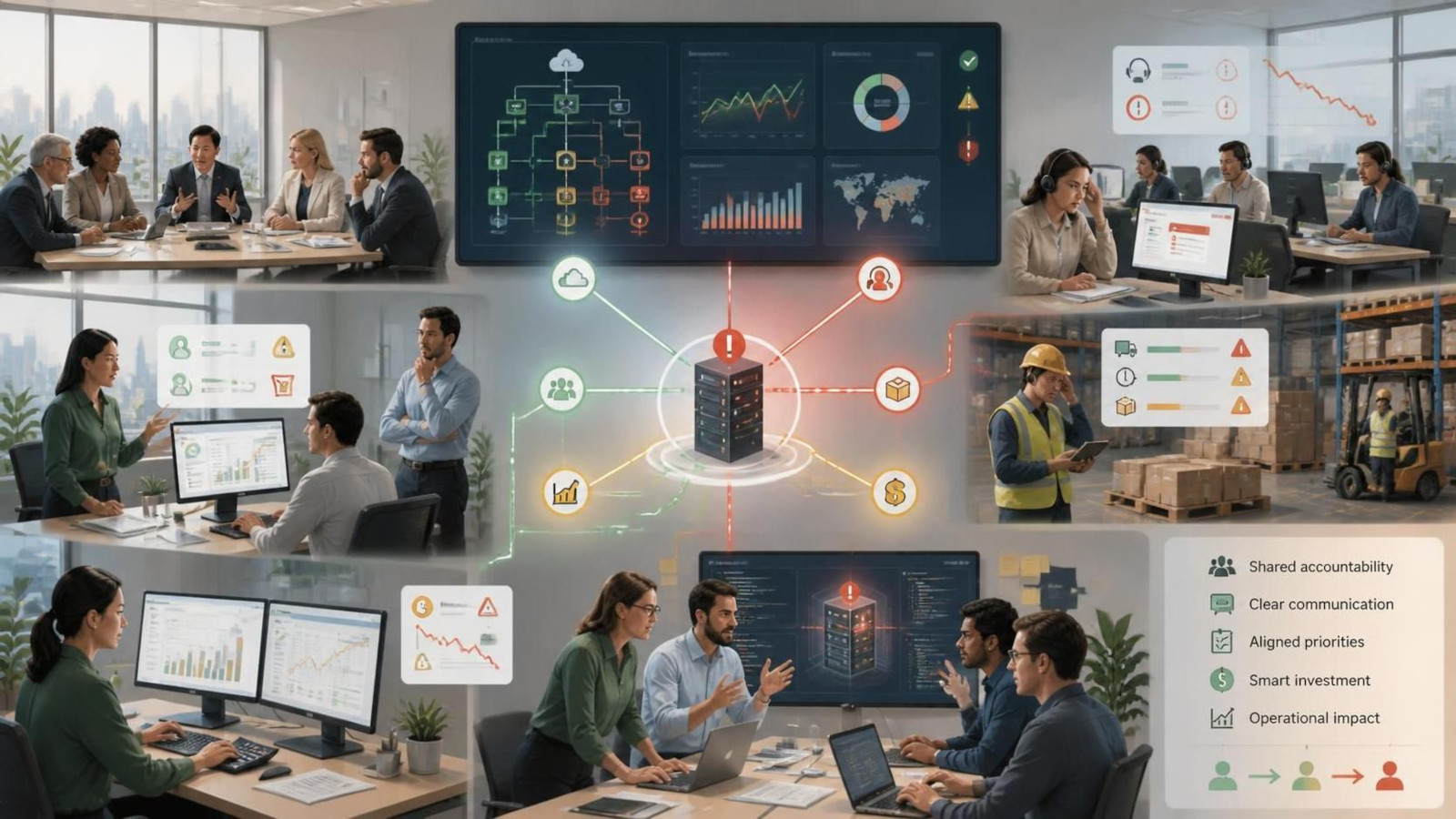
When organizations invest in new platforms, upgrade their systems, or embark on ambitious digital strategies, there is a common and tempting assumption: if the technology is modern, the results will follow. Yet time and again, businesses with cutting-edge tools, generous budgets and talented engineers still see their initiatives run over time, over budget, and fail to deliver the value they promised. Conversely, organizations with far more modest technical estates can build fast, reliable and impactful digital experiences that meaningfully improve their performance.
This disparity reveals an uncomfortable truth: technology performance is not primarily a technical problem, but an organizational one. Code, infrastructure and architecture matter, but they are never the sole determinants of success. Instead, the value technology creates is shaped by leadership, operating models, capabilities and collaboration. How an organization sets priorities, makes decisions, builds skills and works together will ultimately determine whether its technology enables growth and agility, or becomes a constant source of frustration and drag.
Leadership: Setting direction, priorities and accountability
At the root of strong technology performance is clear and consistent leadership. Technology cannot deliver value unless leaders can confidently answer a deceptively simple question: What are we trying to achieve, and why? Without that clarity, engineering teams are left to interpret vague requests, leading to a stream of features that look impressive but fail to solve the problems that matter most to the business.
Good technology leadership begins by focusing on outcomes rather than outputs. There is a critical difference between celebrating "we delivered fifty user stories this quarter" and asking, "did this release improve customer experience, reduce cost, mitigate risk or grow revenue?" Too many organizations measure success by project completion instead of the value created after launch. Leaders who consistently reframe conversations around outcomes give their technology teams the autonomy to find the best technical solution, rather than blindly following a prescriptive list of requirements.
"Technology creates value through an organization, not in isolation from it."
Equally important is the courage to make trade-offs. Every technology portfolio must balance competing demands: building new products, fixing technical debt, strengthening security, maintaining reliability and responding to urgent requests. Without deliberate prioritization, everything becomes equally urgent, and teams become reactive, stretched thin and unable to invest in long-term performance. Effective leaders have the discipline to say "not now" to low-value work and to justify necessary investments in resilience, scalability and maintainability, even when they lack the immediate glamour of a new customer-facing feature.
Most critically, leaders must establish shared accountability for technology outcomes. Treating technology as something "IT owns" while the rest of the business simply throws requirements over the wall is one of the fastest ways to erode value. Digital performance depends on business and technology working towards the same goals, which means accountability cannot sit with a single function. When executives treat technology as a strategic capability and take joint ownership of its success, it shifts from being a cost center to becoming a genuine enabler of competitive advantage.
Operating models: Designing how work gets done
While leadership sets the destination, an organization's operating model determines how quickly and effectively it can get there. Even brilliant strategies will falter if decision-making is slow, work is fragmented, or teams are structured in ways that make delivery unnecessarily difficult.
A key distinction lies between project-based and product-based ways of working. Many organizations still organize their technology efforts around short-term projects with fixed end dates. While this can work for one-off implementations, it often discourages ownership once a system goes live. Product-based operating models, on the other hand, assign enduring, cross-functional teams to the services and experiences customers rely on. With long-term accountability for reliability, usability and performance, those teams are far more inclined to invest in quality, reduce technical debt and continuously improve what they've built.
The speed of technology performance also hinges on decision rights. If every design choice, technical approach or prioritization decision must escalate to a committee, delivery grinds to a halt. High-performing organizations push decisions as close to the people doing the work as possible, clearly defining which decisions must be centralized for consistency and which can be safely empowered to teams. Clarity over who can decide prevents bottlenecks without sacrificing security, compliance or architectural coherence.
This is often reflected in the principle that organizations design systems that mirror their communication structures. Known widely as Conway's Law, it means if business and technology teams operate in rigid silos, the systems they build will be fragmented and difficult to integrate. If they work in collaborative, cross-functional teams aligned to customer journeys or value streams, their technology is far more likely to be seamless, reliable and easy to evolve. For this reason, operating model design is as influential on system quality and performance as any technical architecture decision.
Finally, funding must reinforce the desired outcomes. When resources are only allocated to new project builds with hard cut-offs, teams have little room to harden, refactor or improve existing platforms. By contrast, organizations that invest in maintaining, observing and scaling their critical services recognize that day-to-day performance is what preserves trust with customers. Reliability isn't an afterthought; it's a product of sustained, intentional investment.
Capabilities: Building what the organization can actually deliver
No matter how well-designed an operating model may be, technology performance will fall short if people lack the capabilities to deliver, maintain and evolve it. Technology changes constantly, but the long-term advantage lies not in chasing every new trend, but in building enduring skills, judgment and institutional knowledge.
Strong performance requires a blend of technical, domain and product capabilities. Engineers must be able to design scalable, secure and resilient systems, but value is only created when they also understand the business context in which those systems operate. Equally important are product and data skills that help teams distinguish between what is technically possible and what will genuinely solve user problems. When teams deeply understand their customers, regulations, processes and revenue drivers, they make better technical decisions and avoid building unnecessary complexity.
Crucially, organizations must distinguish between delivery capacity and delivery capability. Having enough people to write code is different from having the collective expertise to build secure, maintainable, and well-integrated solutions. Prioritizing short-term speed by cutting corners may appease deadlines, but it accumulates technical debt that slowly degrades performance, increases risk and makes future change painfully expensive. Building capability means leaving space for quality, testability, documentation, observability and good engineering practices.
This cannot be left to chance and must be actively developed. Learning, mentoring, knowledge sharing and internal mobility are vital for preventing critical knowledge from being trapped in only one or two individuals. Investing in upskilling, rotating engineers across domains, and capturing design decisions helps organizations remain resilient as people move on.
Most importantly, organizations need to cultivate critical judgement. With an endless array of tools and approaches available, success depends on knowing when to build, when to buy, when to integrate, and when to simplify. Those decisions are rarely purely technical; they require commercial awareness, risk judgement and an honest assessment of what the organization can sustainably operate and support long after implementation. In the long run, prudent judgement creates far more value than chasing novelty.
Collaboration: Turning shared goals into shared value
If leadership, operating models and capabilities create the foundations, collaboration is what brings them to life. Technology performance almost never fails for a single, dramatic reason. It most often erodes through a thousand small moments of misalignment, unclear assumptions and handoffs between functions.
The most persistent weakness in many organizations is the divide between "the business" and "technology". When business stakeholders act as passive requesters and technology teams act as order-takers, both lose sight of the customer and shared outcomes. High-performing organizations break this divide by forming cross-functional teams where product, design, engineering, data, quality, risk and subject-matter experts work together from the earliest stages of discovery. Problems are framed and solved collectively, which prevents costly rework caused by late-stage surprises.
This level of alignment requires a shared language and mutual respect. Non-technical stakeholders do not need to learn how to write code, and engineers do not need to become accountants, but they must be able to understand each other's constraints and trade-offs. Creating space for open, honest dialogue builds trust, allowing teams to have productive conversations about complexity, risk, timelines and cost instead of defaulting to blame when challenges arise.
Trust also enables early discovery and continuous feedback. The greatest cost in technology is building the wrong thing well. Collaborating with users and stakeholders from problem definition through to testing and post-launch allows teams to validate assumptions early, learn quickly and adjust before investing heavily. Short feedback loops not only improve quality and performance, but also increase relevance for the people relying on those systems.
Just as vital is psychological safety. In complex systems, mistakes, edge cases and unknowns are inevitable. Teams must feel safe to raise technical risks, flag feasibility concerns, admit what they don't know, and challenge flawed assumptions without fear of being seen as obstructive. When people can speak candidly, risks are surfaced earlier, reliability improves, and better decisions are made. Conversely, cultures that punish candor tend to reward optimism instead of honesty, which is a dangerous combination for any technology-dependent business.
"Technology may enable the result, but the organization determines what is possible."
Most fundamentally, collaboration thrives when everyone is united by shared outcomes. When engineers are measured only on throughput and business teams only on their own deadlines, incentives naturally pull in opposite directions. When both share responsibility for customer satisfaction, adoption, reliability and business value, their priorities converge. That unity of purpose is often the difference between a functional handoff and genuine partnership.
Why it all must work together
None of these levers operate in isolation. Strong leadership without an enabling operating model will create ambitious strategies that teams cannot realistically deliver. Capable engineers will struggle in siloed structures where collaboration is poor. Even the best cross-functional teams will lose momentum if leaders constantly reward short-term feature requests at the expense of stability and performance.
These forces compound over time. When organizational alignment is strong, technology becomes easier to change, safer to scale, more resilient under pressure and quicker to respond to new opportunities. When it is weak, complexity multiplies, technical debt builds, change slows down, and what should be an advantage gradually becomes a liability. In many organizations, declining agility has less to do with ageing infrastructure than it does with aging decision-making, incentives and ways of working.
A question to consider
Where does your organization need its technology leadership to create the conditions in which technology consistently produces value?
The answer may reveal a need for stronger leadership commitment, operating-model redesign, sustained capability building, and collaboration across traditional boundaries.
Conclusion
It is tempting to view slow systems, failed digital initiatives or underwhelming returns as evidence that we need better technology. More often, they are evidence that we need better organization.
Technology only creates value when it helps people solve meaningful problems, and that value is determined by human decisions about what to prioritize, how to build, who is empowered to act, and how well people work together. Leadership provides clarity of purpose, operating models enable flow and speed, capabilities ensure quality and sound judgement, and collaboration keeps everyone focused on shared outcomes.
Ultimately, technology performance is an organizational issue because value isn't written in the code – it's created through the decisions, habits and relationships of the people building and using it. For that reason, the most powerful investment any organization can make in its technology is not simply upgrading its platforms, but strengthening how it leads, works and collaborates.